

Table of Contents
- Why Buy Locally Crafted Souvenirs? The Case for Authentic Keepsakes
- How Buying Local Supports the Economy and Cultural Heritage
- How to Identify Authentic Souvenirs: A Practical Checklist
- Best Souvenirs for World Travelers: What to Look For
- The Environmental and Ethical Case for Locally Crafted Souvenirs
- Budgeting for Artisan Goods: What You're Really Paying For
- Frequently Asked Questions
Last Updated: September 16, 2026
Why Buy Locally Crafted Souvenirs? The Case for Authentic Keepsakes
The reason to buy locally crafted souvenirs is simple: they carry a story, a place, and a person's work in a way that a factory-stamped trinket never can. This guide from FootWhere examines the economic, cultural, and ethical arguments for choosing handmade keepsakes, plus the practical questions most travelers never get answered.
Here's what matters most: a souvenir is only worth packing if it reminds you of a specific place, not just "a trip." That distinction drives everything below, from how to spot real craftsmanship to how to budget for it. We'll cover the verification checklist, the ethics framework, and the logistics of getting fragile items home in one piece.
A locally crafted souvenir is a keepsake made by artisans in or near the destination it represents, using materials and techniques tied to that region's traditions. It differs from mass-produced tourist merchandise in origin, materials, and the economic chain it supports.
How Buying Local Supports the Economy and Cultural Heritage
Every dollar spent with a local artisan stays closer to the community than a dollar spent at an airport gift chain. That's the core economic argument, and it's the one most souvenir guides skip past.
Economic Impact on Communities
Money paid directly to artisans supports small-scale production, local suppliers, and often family businesses that have operated for generations. When travelers buy handcrafted goods instead of mass-produced imports, they keep traditional crafts economically viable. Many artisans find that consistent tourist demand is what allows them to keep working in a craft at all.
Preserving Traditional Crafts and Stories
Cultural preservation happens one purchase at a time. A weaving technique, a pottery style, or a carving tradition survives because someone can make a living from it. Buying directly from makers also means hearing the story behind the object, which is where heritage preservation becomes personal rather than abstract.
How to Identify Authentic Souvenirs: A Practical Checklist
Authenticity is verifiable, not just felt. Use this six-step checklist before you commit to a purchase.
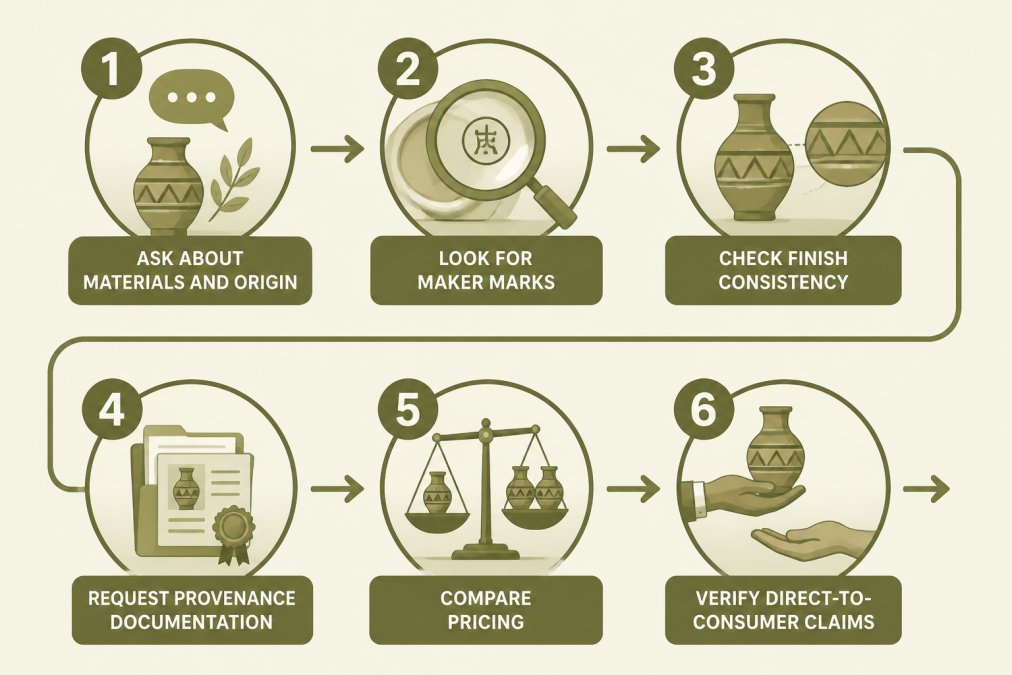
- Ask about materials and origin. A real artisan can name the material and where it came from.
- Look for maker marks or signatures. Unsigned work isn't automatically fake, but a mark is a good sign.
- Check for consistent quality and finish. Handmade items vary slightly; suspiciously uniform "handmade" goods often aren't.
- Request provenance documentation. Certificates of origin or workshop receipts add confidence.
- Compare pricing against mass-produced alternatives. A price far below the local norm usually signals factory production.
- Verify direct-to-consumer or fair trade claims. Ask who made it and how the maker was paid.
Best Souvenirs for World Travelers: What to Look For
The best souvenirs for world travelers share three traits: they're small, durable, and tied to a specific place. That combination makes them easy to pack and hard to confuse with anything else.
Categories worth prioritizing:
- Textiles: scarves, woven bags, and small rugs that fold flat
- Ceramics and small carvings: check for cracks and pad them well
- Metalwork and jewelry: compact, durable, and often signed by the maker
- Paper goods and prints: lightweight and easy to transport
- Location-specific keepsakes: items that name the exact place you visited
That last category matters more than most travelers realize.
The Environmental and Ethical Case for Locally Crafted Souvenirs
Locally crafted souvenirs typically carry a smaller carbon footprint than mass-produced imports because they travel shorter distances and are made in smaller batches. That's the environmental case, and it's straightforward. The ethical case is harder, because "local" and "ethical" are not the same claim, and most souvenir guides blur them together.
Louisville FootWhere Souvenir →
A Souvenir Ethics Framework
Instead of asking only "is this local?", run each purchase through four questions. This is the framework most guides skip.
- Origin of materials. Were the raw materials sourced from the region the item claims to represent, or imported and merely assembled nearby? A locally assembled item made from imported components supports far less of the local supply chain than the label implies.
- Labor conditions. Who made it, and were they paid fairly for their time? A locally owned workshop can still underpay workers. Ask whether the maker is a named individual, an employee, or an anonymous contractor.
- Cultural permission. Does the item draw on a tradition the maker belongs to, or is it a copy of a closed or sacred practice sold as decoration? Cultural appropriation is a real risk in souvenir markets, and it is distinct from craftsmanship quality.
- Economic retention. How much of the purchase price stays with the maker versus a middleman, distributor, or import chain? A high price does not guarantee a high share to the artisan.
Why This Matters Beyond Feel-Good Shopping
Conscious consumerism isn't a slogan here; it's a purchasing decision with a visible chain behind it. When you buy directly from an artisan or a fair trade retailer, you have a reasonable chance of knowing who made the item and how they were compensated. When you buy from an intermediary, that chain becomes opaque, and opacity is where both cultural appropriation and unfair labor practices hide.
Budgeting for Artisan Goods: What You're Really Paying For
Artisan goods cost more because they contain more labor, better materials, and often a longer production time. That's the honest answer to "why is this keychain more than the one at the airport?" But knowing why they cost more doesn't tell you how to budget for them, and that's the part most guides leave out.
| What You're Paying For | Mass-Produced Item | Locally Crafted Item |
|---|---|---|
| Labor | Assembly line, minimal hours | Skilled maker, hours per piece |
| Materials | Cheapest available | Often local, higher grade |
| Origin story | Generic or none | Tied to a specific place |
| Durability | Often replaced quickly | Built to last |
| Economic impact | Leaves the community | Stays local |
Closing the Price Gap Without Overspending
The gap between a cheap import and a fairly priced handmade item is real, and it is usually driven by labor hours rather than materials. A common pattern is that the handmade version costs several times the imported version, not because the artisan is overcharging, but because a single maker may spend hours on an item a factory produces in minutes.
A few budgeting approaches that work in practice:
- Allocate per destination, not per item. Set a fixed souvenir budget for each place you visit, then decide how to spend it. This prevents impulse buys from eating the whole trip's budget.
- Prioritize one meaningful piece over several cheap ones. A single well-made, location-specific item often outlasts a bag of generic trinkets, so the cost per year of ownership can be lower.
- Buy small when the budget is tight. Keychains, magnets, zipper-pulls, and prints carry the same story as larger pieces at a fraction of the cost.
- Ask about maker-direct pricing. Buying straight from the artisan or a cooperative often removes a retail markup, which can narrow the gap between handmade and mass-produced.
What the Extra Cost Actually Buys
Set a realistic budget before you travel, and frame the spend in terms of what it returns: a specific place, a named maker, and a keepsake you'll actually keep. For a small keepsake like a keychain, magnet, or zipper-pull, FootWhere's items are priced at $7.99 each, which keeps a meaningful, location-specific memento within reach of most travel budgets.
Frequently Asked Questions
What makes a souvenir authentic?
An authentic souvenir is made by local artisans using traditional methods and materials from that region. Look for maker marks, ask about the production process, and verify that the item reflects the destination's cultural heritage. Mass-produced items often lack these details and may be imported from overseas. Authentic souvenirs tell a story and support the local economy through fair trade practices.
How does buying local support the economy of a destination?
When you buy locally crafted souvenirs, more money stays in the community. Local artisans and small businesses reinvest in their neighborhoods, creating jobs and funding community development. This economic impact is especially important in tourism-dependent areas where mass-produced imports often drain profits away from the region. Choosing handmade goods keeps traditional crafts alive and strengthens the local supply chain.
Why are locally crafted items better for the environment?
Locally crafted souvenirs typically have a smaller carbon footprint because they don't require long-distance shipping from overseas factories. Artisans often use locally sourced materials and small-scale production methods that generate less waste. Unlike mass-produced goods, these items are usually made to last, reducing the cycle of disposable consumption. Supporting sustainable practices also encourages ethical consumption and social responsibility.
How can you identify genuine artisan-made souvenirs?
To identify genuine artisan-made souvenirs, examine the item for inconsistencies that indicate handcrafting, such as slight variations in color or texture. Ask the seller about the maker and the materials used. Look for certificates of authenticity or provenance documentation. Visit artisan workshops or cooperatives when possible. Avoid items that look identical to those sold in every shop, as these are likely mass-produced imports.