

Table of Contents
- What Makes a Souvenir Ethical and Authentic
- How to Verify Made in USA Labels and Claims
- Best USA-Made Gifts for Travelers and Collectors
- Supporting Local US Craftspeople Online
- Step-by-Step Process to Find Ethical Souvenirs
- Red Flags to Avoid When Shopping for Ethical Souvenirs
- Frequently Asked Questions
Last Updated: September 24, 2026
What Makes a Souvenir Ethical and Authentic
An ethical US-made souvenir is a handcrafted item produced domestically with transparent labor practices, sustainable materials, and verifiable supply chain transparency. It acknowledges where you've actually been while supporting domestic artisans and small manufacturers.
Most mass-produced souvenirs sold in airport gift shops are made overseas, shipped thousands of miles, and wrapped in plastic. Ethical souvenirs connect you to a real place and a real maker.
When you buy an authentic, domestically-crafted souvenir, you're supporting local economies, reducing your shipping carbon footprint, and getting something that tells a story. FootWhere creates souvenirs containing genuine soil from destinations you've visited, made in the USA.
Authentic souvenirs have three hallmarks: verifiable origin, transparent labor practices, and honest materials. Real ethical souvenirs back up claims with proof; vague "eco-friendly" labels are just marketing.
How to Verify Made in USA Labels and Claims
Not every "Made in USA" label means what it claims. The FTC has specific rules, but enforcement gaps exist. You need to decode labels and spot greenwashing tactics that hide overseas sourcing.
Understand FTC Standards and Common Loopholes
The FTC requires "Made in USA" products to have all significant parts or processing occur domestically, but the "all or virtually all" standard is vague enough to create loopholes.
"Made in USA": All significant parts and processing happen domestically.
"Assembled in USA": Only final assembly is domestic; components may be imported. Legal but misleading.
"Designed in USA": Design is domestic; manufacturing is overseas. Pure marketing.
"Made in USA with imported materials": Transparent about sourcing, a trust signal.
"Product of USA": Equivalent to "Made in USA" under FTC standards.
The FTC's Complying with the Made in USA Standard explicitly states that companies cannot use "Made in USA" if any significant component is imported or if significant processing occurs overseas. Yet many sellers use vague language to skirt this rule.
Spot Greenwashing Red Flags on Product Labels
Vague geographic claims: Labels claim "Made in USA" but list a manufacturer address abroad. Always cross-reference the label with the actual manufacturer address.
Percentage claims without documentation: "95% USA-made" is meaningless without proof. Legitimate makers provide breakdowns.
Emphasis on one component: "USA-made leather" hides that other parts are imported. Read the full label.
Eco-language without origin clarity: "Sustainable" and "eco-friendly" say nothing about where something is made. Ethical sourcing requires both sustainable materials AND domestic production.
Missing facility information: Legitimate producers list a physical manufacturing address. If you can't find one, the maker is likely hiding something.
Use Verification Tools and Direct Inquiry
Several resources help you verify domestic manufacturing claims:
The American Made Campaign directory (Made in America directory) maintains a searchable database of certified domestic manufacturers. This is your most reliable verification tool because listings require proof of US production.
UPC code lookup. Search a product's UPC code through the GS1 US database to find the registered manufacturer. Cross-reference the manufacturer's address with the label's claim.
Customs and tariff databases. The USA International Trade Commission maintains import/export data. If a product is listed as imported, it's not made here, regardless of what the label claims.
Atlanta FootWhere Souvenir Zipper-Pull. →
Direct contact with the seller. Email and ask: "Where is this product manufactured?
Request and Review Supply Chain Documentation
Request documentation including: facility street address and operational dates; material sourcing breakdown by component; third-party labor certifications (Fair Trade USA, B Corp); environmental impact assessments; and packaging/shipping details. If the seller can't provide specifics, they're likely reselling imported goods.
Best USA-Made Gifts for Travelers and Collectors
The best ethical souvenirs balance authenticity with practicality. Location-specific keychains and zipper-pulls acknowledge where you've been, FootWhere's sets ($35.99) contain genuine soil and are made in the USA. Fridge magnets serve as daily reminders. Handcrafted pottery and textiles from regional artisans support local craftspeople. Artisan food products combine ethical sourcing with practical gifting. Custom items commissioned directly from makers ensure authenticity.

Supporting Local US Craftspeople Online
Buying directly from makers strengthens local economies and eliminates middlemen markups. Finding authentic regional artisans requires knowing where to look and how to verify they're actually local, since generic marketplaces mix domestic and imported goods.
Find Verified Regional Artisan Directories and Cooperatives
State-level artisan directories verify that listed makers operate in-state and produce domestically. Search "[your state] artisan directory" to find your region's official resource.
Evaluate Marketplace Seller Verification Requirements
Platforms with seller verification require proof of production location before listing. Note: Etsy's "Made in USA" filter is user-reported, not verified, always cross-check with the seller.
Leverage Social Media and Maker Communities for Discovery
Instagram and maker accounts: Search hashtags like #[your state]made. Accounts with workshop photos and production steps are transparent; accounts with only polished product photos are less trustworthy.
Connect Directly with Makers for Customization and Transparency
Direct communication with artisans offers advantages retail intermediaries can't: custom commissions let you specify materials and ethics standards; faster supply chain answers come from the actual maker; higher maker income from direct sales; and relationship building with repeat customers.
Step-by-Step Process to Find Ethical Souvenirs
Finding authentic ethical US-made souvenirs requires a structured approach. Follow these five steps to verify authenticity and ensure your purchase supports real domestic craftsmanship.
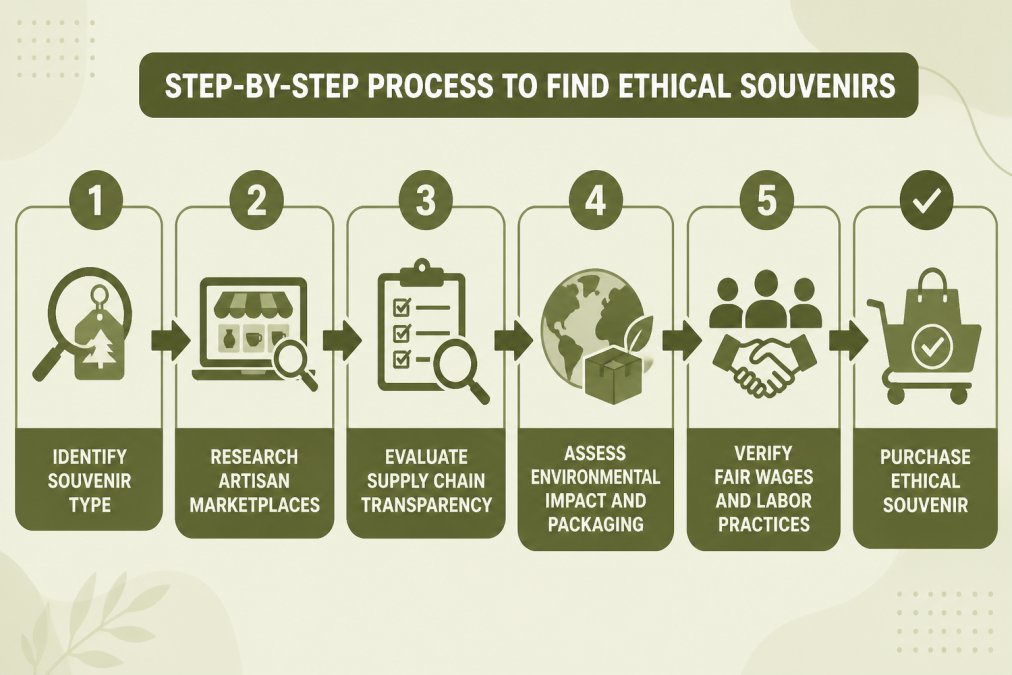
Step 1: Identify Your Souvenir Type and Purpose
Define what you want: personal keepsake, gift for a traveler, collection item, or budget range. This clarity prevents impulse purchases and helps you evaluate against actual criteria rather than marketing claims.
Step 2: Research Artisan Marketplaces and Direct-to-Consumer Sellers
Research marketplace types: regional artisan cooperatives, maker platforms with seller verification, independent craftspeople websites, ethical retailers, and specialty souvenir makers. Check each seller's "About" section for location, production methods, materials sourcing, and workshop photos.
Step 3: Evaluate Supply Chain Transparency
Contact the seller asking: Where is this made (facility address)? What are the materials and origins? Who makes it? How long in business? Do you have labor practice certifications? Transparent answers indicate trustworthy sellers; vague responses warrant caution.
Step 4: Assess Environmental Impact and Packaging
Ethical sourcing includes environmental stewardship. Evaluate:
- Materials: Are they sustainable, recycled, or responsibly sourced?
- Production waste: Does the maker minimize scrap or waste?
- Packaging: Is it plastic-free, recyclable, or compostable?
- Shipping: How is the item packaged for transit? Excess packaging inflates carbon footprint.
FootWhere's products use high-quality acrylic sealed with ultrasonic welding, durable enough to last a lifetime. This approach reduces waste while ensuring your souvenir survives travel.
Step 5: Verify Fair Wages and Ethical Labor Practices
Ethical sourcing means fair compensation and safe working conditions. Look for:
- Labor certifications: Fair trade, B Corp, or similar third-party audits
- Wage transparency: Does the maker publish wage information or share it on request?
- Worker benefits: Health insurance, paid time off, safe conditions
- Community impact: Does the business reinvest in its local community?
Red Flags to Avoid When Shopping for Ethical Souvenirs
Vague country-of-origin claims. If a label says "Assembled in USA" or "Designed in USA" but doesn't specify where materials come from or what percentage is domestic, it's likely not fully made here. Authentic makers state "Made in USA" clearly and back it up.
No customer reviews or photos. Legitimate sellers have reviews from real buyers. More importantly, they display customer photos showing the actual product. If a marketplace has only stock photos and no real-world images, the authenticity is questionable.
Frequently Asked Questions
How can I verify if a souvenir is truly made in the USA?
Check the product label for 'Made in USA' designation, which must comply with FTC guidelines requiring substantial U.S. manufacturing. Contact the seller directly and request documentation of where production occurs. Look for artisan marketplaces that publish supply chain transparency information. Authentic US-made souvenirs often include details about the specific location or craftsperson. FootWhere's souvenirs, for example, clearly state they're made in the USA and contain genuine soil from the featured destination, providing traceability that mass-produced items typically lack.
What makes ethical US-made souvenirs different from mass-produced airport gifts?
Ethical US-made souvenirs support domestic manufacturing and fair wages for American craftspeople, reducing carbon footprint through shorter supply chains. They prioritize sustainable sourcing, zero-waste packaging, and authentic craftsmanship over volume production. Mass-produced airport items often use greenwashing claims without transparency. Ethical souvenirs like destination-specific keychains or magnets with genuine local materials offer meaningful connections to places you've visited while supporting local economies and environmental stewardship.
Are there online marketplaces dedicated specifically to American artisans and craftspeople?
Yes, several platforms focus on supporting local US craftspeople. Direct-to-consumer artisan websites often showcase handcrafted items with full supply chain transparency. Regional artisan directories organize makers by location, making it easy to find souvenirs tied to specific destinations. Social enterprise platforms highlight small-batch production and community development initiatives. FootWhere operates as a direct-to-consumer maker, allowing you to purchase destination souvenirs knowing exactly where and how they're produced, with genuine soil from each location included.
What should I look for to avoid counterfeit or greenwashed souvenirs?
Avoid vague claims like 'eco-friendly' without certification details. Verify 'Made in USA' labels comply with FTC standards, legitimate sellers provide manufacturing location specifics. Be skeptical of extremely low prices for items claiming ethical production; fair wages and sustainable practices cost more. Check for third-party certifications like Fair Trade or B-Corp status. Request photos of production facilities or craftspeople. Authentic souvenirs include product lifecycle transparency. Sellers who hide supply chain information or use generic stock photos are red flags.