

Table of Contents
- What Makes Temple Mount Soil Souvenirs Different
- How to Verify Souvenir Authenticity Before You Buy
- Collecting Soil from Visited Places: What Travelers Should Know
- Temple Mount Soil vs Competitors: Side-by-Side Comparison
- The Legal and Ethical Side of Sacred Soil Keepsakes
- Why Some Travelers Choose FootWhere Instead
- Conclusion
- Frequently Asked Questions
Last Updated: September 22, 2026
What Makes Temple Mount Soil Souvenirs Different
Temple Mount soil souvenirs are keepsakes that contain a small amount of earth collected from the Temple Mount in Jerusalem, sealed inside a keychain, pendant, or display vial. The appeal is simple: a physical connection to one of the most historically significant sites on earth. This guide from FootWhere examines how these items differ from other destination soil souvenirs, how to verify authenticity, and what to weigh before buying.
The category has grown alongside a broader trend of collecting soil from visited places. Travelers who once settled for a generic magnet now want something tied to the actual ground they walked on.
What makes the Temple Mount version distinct is the site itself. The Temple Mount is sacred to three major faiths and sits at the center of centuries of history. Soil from there carries religious and emotional weight that a beach souvenir never will.
That significance also creates the category's biggest problem: authenticity. A vial of dirt is easy to fake and hard to disprove.
How to Verify Souvenir Authenticity Before You Buy
How to verify souvenir authenticity comes down to three things: documentation, seller transparency, and physical presentation. A legitimate seller will happily answer questions about where the soil came from and how it was collected. A vague answer is your first red flag.
Here is a practical checklist for evaluating any destination soil seller:
- Does the listing state the specific collection location and date?
- Is there a certificate of authenticity or collection record included?
- Does the seller name a real business address or registration?
- Are there clear, unedited customer photos of the actual product?
- Does the seller explain how the soil is sealed and preserved?
- Can you find independent reviews outside the seller's own site?
Run every seller through this list before you enter payment details.
Questions to Ask Any Destination Soil Seller
Ask directly, and judge the quality of the answer, not just its existence.
- "Where exactly was this soil collected, and when?"
- "What documentation ships with the item?"
- "How is the soil sealed, and will it stay contained in transit?"
- "Can you show me photos from the collection trip?"
- "What is your return policy if I am not satisfied?"
A seller who answers all five with specifics is worth your money. One who deflects is not.
Collecting Soil from Visited Places: What Travelers Should Know
Collecting soil from visited places is a personal practice, but it runs into real rules. Many heritage sites, national parks, and religious locations prohibit removing anything from the grounds, including soil. Removing material can carry fines or worse depending on the site and jurisdiction.
That is the tension most travelers never think about. The souvenir you want may not be legal for you to gather yourself.
The practical answer is to buy from sellers who collect with permission or under an agreement with site authorities. If a seller cannot explain how they obtained the soil legally, assume they did not.
- Check site rules first. Look up the specific regulations for any location before you pocket anything.
- Never collect from restricted or sacred areas. The risk is not worth the keepsake.
- Buy from documented sources. A seller with transparent collection practices removes the legal question from your hands.
- Keep it small and sealed. Even legally obtained soil should be contained to avoid customs or agricultural issues.
Temple Mount Soil vs Competitors: Side-by-Side Comparison
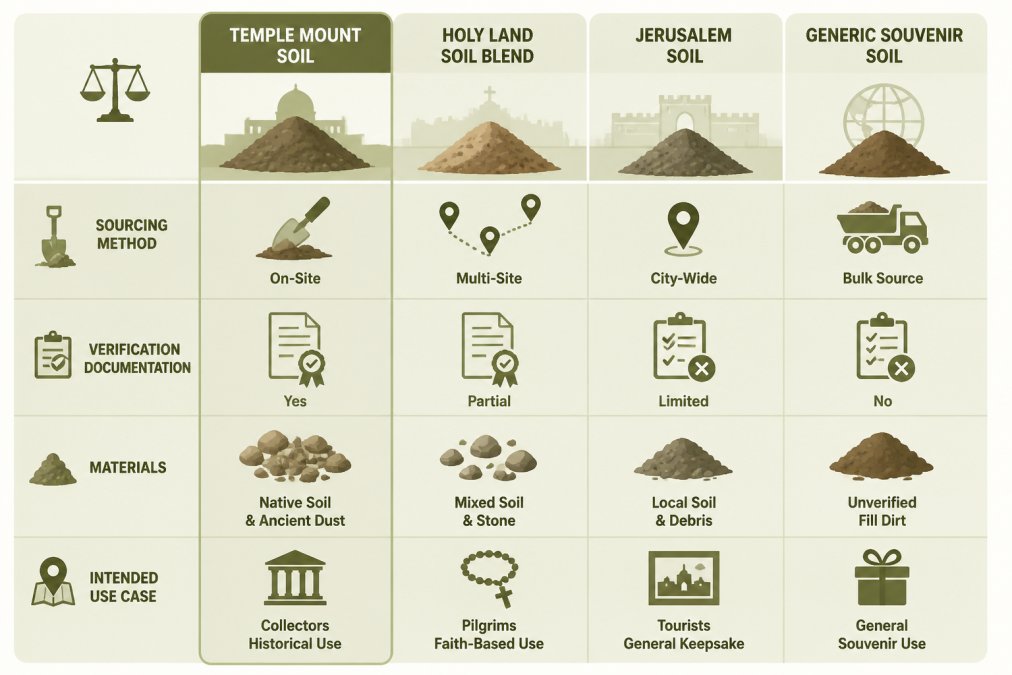
The table below compares destination soil souvenirs across the factors that actually matter to a buyer: sourcing method, verification, materials, and intended use.
| Factor | Temple Mount Soil Souvenirs | Other Destination Soil Souvenirs | FootWhere |
|---|---|---|---|
| Sourcing method | Claimed collection from the site | Varies widely by seller | Genuine soil from the featured destination |
| Verification | Often a printed label only | Inconsistent | Soil sealed in the item's foot cavity |
| Materials | Vials, pendants, keychains | Vials, resin blocks, jars | Keychains, magnets, postcards, zipper-pulls |
| Intended use | Religious or historical keepsake | General travel memento | Personal keepsake or custom gift |
| Origin of manufacture | Rarely stated | Rarely stated | Made in the USA |
The Legal and Ethical Side of Sacred Soil Keepsakes
Sacred soil keepsakes raise questions that a normal souvenir never does. Soil from a religious site is not just dirt. For many buyers, it carries spiritual meaning, and for some communities, removing it at all is sensitive.
On the legal side, the rules vary by location. Some sites ban removal outright. Others permit it only with authorization. The U.S. Customs and Border Protection guidance on bringing agricultural items into the country is also worth checking if you travel internationally, since soil can fall under agricultural restrictions.
The ethical side is simpler to state. Buy from sellers who respect the site and document their practices. A seller who cannot explain their ethics probably does not have any.
Why Some Travelers Choose FootWhere Instead
FootWhere approaches destination souvenirs differently. Instead of a loose vial of soil, each item is crafted with a foot cavity that holds genuine soil from the featured destination. The soil is part of the object, not an add-on.
The catalog covers keychains, fridge magnets, postcards, and zipper-pulls, so there is an option for a personal keepsake or a gift. Every item is made in the USA, which matters to buyers who want to know where their purchase was assembled.
For travelers collecting soil from visited places, the appeal is that the soil is tied to a specific location and sealed into an item you can actually display. It answers the "will this end up in a drawer" worry directly.
For gift givers, the framing is easier than it sounds. You are not handing someone dirt. You are handing them a marker of a place they set foot in, and the foot cavity makes that idea visible at a glance.
Pricing depends on the item and any customization you choose, so check the current collection for details.
Conclusion
The hard part of buying a destination soil souvenir is not finding one. It is finding one you can trust. Verification, sourcing, and materials separate a meaningful keepsake from a gimmick.
FootWhere builds each item around genuine soil from the featured destination, seals it in a foot cavity, and makes every piece in the USA. If you want a keepsake that acknowledges where you have actually set foot, explore the collection and find the destination that matters to you.
Smithsonian guidance on preserving and displaying personal collections
Frequently Asked Questions
How can you verify the authenticity of soil souvenirs?
Ask the seller for documentation of where and when the soil was collected, and whether they provide a certificate of authenticity. Reputable sellers explain their sourcing process clearly. For temple mount soil keepsakes specifically, check whether the item identifies the collection site and date. If a seller cannot describe how the soil was obtained, treat that as a red flag. You can also look for customer photos and reviews that show the product in person.
Are there legal regulations regarding the collection of soil from historical sites?
In the United States, removing soil or artifacts from federal lands, including national parks and monuments, is prohibited under the Archaeological Resources Protection Act. State and local sites have their own rules. International sites may have stricter laws. If you plan to collect soil from visited places during your travels, check the site's rules before pocketing anything.
What is the difference between commercial sacred soil and archaeological sifting samples?
Commercial sacred soil is collected and packaged for sale as a keepsake, often with documentation of the site. Archaeological sifting samples come from organized excavation projects where volunteers sift through material to find artifacts; the remaining soil is sometimes offered as a memento. The key differences are provenance paperwork. Sifting samples are limited and tied to a specific project.
How does FootWhere ensure the authenticity of their destination soil?
FootWhere sources genuine soil from each featured destination and seals it inside the foot cavity of every item, so you can see the soil itself rather than taking a label's word for it. Each piece is made in the USA and tied to a specific location. If you want details on sourcing for a particular destination, contact the company directly before ordering. Customer photos on the site show what the soil looks like in person.
The difference between a souvenir that sits on a shelf for years and one that ends up forgotten comes down to authenticity and craft. FootWhere offers genuine destination soil sealed in a foot cavity, USA-made construction, and customizable options for gifts. Get started with FootWhere and commemorate the places where you have truly set foot.