


Table of Contents
- The Real Costs Behind Authentic Souvenirs
- Authentic vs. Mass-Produced: Why the Price Gap Exists
- Best Souvenirs for World Travelers: Where Value Meets Meaning
- Ethical Souvenir Shopping Tips for Conscious Consumers
- The True Value of Authentic Souvenirs: More Than a Price Tag
- Frequently Asked Questions
Last Updated: September 18, 2026
The Real Costs Behind Authentic Souvenirs
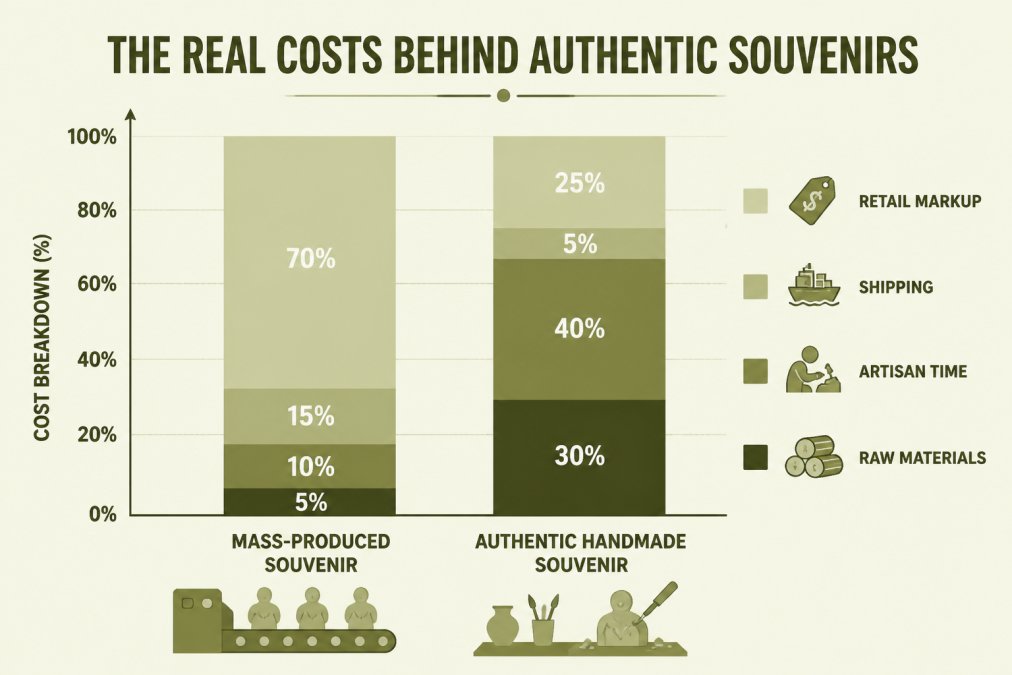
Walk through any airport gift shop and you'll see racks of keychains priced at a few dollars, each stamped with the name of a city you just visited. Then visit a local artisan market, and you'll find a hand-woven textile or carved wooden bowl priced ten times higher. The gap isn't arbitrary. Authentic souvenirs are expensive because they carry real costs that mass-produced trinkets simply don't: raw materials sourced from specific places, hours of skilled labor, and traditional techniques passed down through generations. This guide from FootWhere breaks down exactly where your money goes, so you can decide when the premium is worth it.
Authentic souvenirs are items made by local artisans using regionally sourced materials and traditional methods, as opposed to factory-made trinkets designed for tourists. The price difference reflects genuine production costs, not just marketing.
Raw Materials and Labor Costs
The first cost driver is what goes into the item. A mass-produced magnet uses cheap plastic and printed graphics. An authentic piece might use locally harvested wood, hand-spun fiber, or regionally sourced clay. These raw materials cost more because they aren't bought in bulk from overseas suppliers.
Labor costs follow the same logic. A factory worker producing thousands of identical items per day earns an hourly wage that gets spread across hundreds of units. An artisan making one piece at a time cannot compete on volume. Many businesses find that fair compensation for skilled craft work alone accounts for a significant portion of the final price.
Traditional Techniques and Time Investment
Time is the hidden cost most buyers overlook. A machine can stamp out a thousand keychains in an hour. A weaver might spend an entire day on a single textile. Techniques like hand-carving, natural dyeing, or kiln-firing require both skill and patience that can't be rushed.
What most guides miss is that these techniques often serve a purpose beyond aesthetics. Natural dyes age differently than chemical ones. Hand-carved joints fit tighter than machine-cut ones. The time investment produces something that lasts, which changes the value calculation entirely.
Authentic vs. Mass-Produced: Why the Price Gap Exists
The price gap between authentic and mass-produced souvenirs comes down to three factors: material provenance, labor intensity, and supply chain length. A mass-produced item might pass through five intermediaries before reaching a shelf. An authentic piece often goes from maker to buyer with minimal middlemen.
The Supply Chain Behind the Price Tag
Most guides stop at "handmade costs more" and never explain the logistics. Here is the mechanism, step by step.
Raw material sourcing. A factory buys plastic resin, base metal, and printed graphics by the container load, which spreads the cost across tens of thousands of units. An artisan buys small quantities of regionally specific inputs, a particular clay, a locally harvested hardwood, hand-spun fiber, often from a single supplier or cooperative. Small-volume purchasing means a higher unit cost before any labor is added.
Labor and time. A factory worker producing thousands of identical items per day earns an hourly wage spread across hundreds of units. An artisan making one piece at a time cannot compete on volume. Fair compensation for skilled craft work alone can account for a large share of the final price.
Intermediaries and duties. A mass-produced trinket typically moves through an overseas factory, an exporter, a freight forwarder, an importer, a distributor, and a retailer, each taking a margin. When those goods cross a border, they can also trigger import duties and customs processing fees that get baked into the shelf price.
How to Identify Authentic Handmade Crafts
How to identify authentic handmade crafts: Look for irregularity, provenance, and maker information. Mass-produced items are identical; handmade items show subtle variations.
- Check for maker marks, signatures, or workshop labels
- Ask where materials were sourced
- Look for slight imperfections that indicate hand production
- Compare weight and texture to known factory-made versions
- Request documentation if buying high-value pieces
Spotting Counterfeits and Tourist-Trap Goods
A common mistake is assuming price alone signals authenticity. Some mass-produced items carry inflated price tags in tourist areas, and some genuinely handmade pieces are underpriced because the maker sells directly. Price is a weak test on its own. Use these instead:
- Uniformity test. Pick up three of the "same" item. If they are pixel-identical in color, grain, and finish, they came off a mold or a print line. Handmade goods vary slightly piece to piece.
- Material test. Real wood has grain that continues across a carved edge; resin and plastic have a uniform surface and often a seam line from the mold. Real stone feels cool and heavy for its size; cast resin feels warm and light.
- Maker test. Ask who made it. A vendor who can name the workshop, the region, or the technique is a different signal than a shrug. Vague answers like "local" or "traditional" without specifics are a yellow flag.
- Origin-label test. Read the label carefully. "Designed in" is not "made in." A tag that lists a design studio but no manufacturing location is often a mass-produced import.
- Price-context test. Compare the asking price to similar items at other stalls in the same market. A single vendor charging several times the local norm for an identical-looking item is usually selling markup, not craft.
Best Souvenirs for World Travelers: Where Value Meets Meaning
The best souvenirs for world travelers balance three things: portability, durability, and genuine connection to a place. A large ceramic piece might be authentic but impractical to carry home. A tiny trinket might be portable but meaningless.
Ethical Souvenir Shopping Tips for Conscious Consumers
Ethical souvenir shopping tips start with asking better questions. Who made this? Where did the materials come from? Does the price reflect fair compensation for the maker?
A Price-to-Value Framework for Judging Fairness
Most articles tell you to "buy ethically" without giving you a way to tell whether a price is fair. Here is a simple framework you can run in your head at the stall.
Longevity, Repair, and Disposal
Ethical shopping does not end at the register. The environmental cost of a souvenir is largely determined by what happens to it after you bring it home.
- Durability. Handmade items made from natural materials, wood, clay, natural fiber, metal, can often be repaired. A cracked joint can be re-glued; a worn finish can be refinished. Mass-produced plastic trinkets usually cannot be repaired and are discarded at the first failure.
- Disposal. Natural materials generally break down far more readily than plastic, which persists in landfills for a very long time. A wooden or ceramic piece that eventually wears out returns to the environment far more gracefully than a plastic keychain.
- Repair culture. Many artisans and craft cooperatives will repair or refinish their own work, or can point you to someone who will. That ongoing relationship is part of the value you are buying, and it is something a factory import can never offer.
Certification and Transparency Signals
Fair trade certification helps, but it is not the only signal. Small workshops without formal certification may still pay fair wages. The key is transparency: can the seller tell you who made the item and how?
When you evaluate a seller, look for these signals:
- A named maker, workshop, or cooperative rather than a generic "local artisan" label
- A stated material origin, the region, the supplier, or the technique
- A willingness to answer questions about wages or working conditions
- Consistent pricing across a range of items, which suggests a real cost structure rather than opportunistic markup
- Documentation for high-value pieces, such as a maker's mark, a certificate, or a provenance card
The True Value of Authentic Souvenirs: More Than a Price Tag
Authentic souvenirs carry cultural significance that mass-produced items cannot replicate. They represent place identity, heritage preservation, and the continuation of traditional techniques that might otherwise disappear. When you buy an authentic piece, you're supporting the local economy and the people who keep these crafts alive.
Frequently Asked Questions
How much should you spend on souvenirs?
There is no fixed rule, but many travelers set aside 5-10% of their trip budget for meaningful keepsakes. A $7.99 authentic magnet or keychain from FootWhere offers a tangible connection to a destination without breaking the bank. Focus on items that tell a story rather than accumulating cheap trinkets. The goal is to bring home a few pieces you will actually display or use, not a drawer full of forgettable items.
What makes a souvenir authentic versus mass-produced?
Authentic souvenirs are made by local artisans using traditional techniques, regional materials, and often carry cultural significance. Mass-produced items are factory-made, identical across locations, and lack connection to the place. Check for material provenance, ask about the maker, and look for signs of handcrafting like slight variations. Authentic pieces often come with a story, while mass-produced ones are just products.
Why do tourist traps charge more for low-quality items?
Tourist traps rely on convenience and impulse buying. They mark up low-cost, mass-produced items because they know visitors may not comparison shop. The price reflects location and foot traffic, not quality. To avoid this, shop where locals buy, ask about materials, and look for fair trade or artisan certifications. Authentic souvenirs may cost more upfront but deliver lasting value.
What is the environmental impact of cheap souvenir manufacturing?
Cheap souvenirs often use non-recyclable plastics, toxic paints, and energy-intensive production. They are designed to be disposable, contributing to waste. In contrast, authentic handmade items use natural, local materials and traditional methods with lower environmental footprints. Choosing quality over quantity reduces waste and supports sustainable practices. Look for biodegradable or recycled materials when possible.
Finding a souvenir that genuinely captures where you've been shouldn't mean settling for another mass-produced trinket. FootWhere creates authentic destination keepsakes with genuine soil or sand from the featured location, made in the USA and built to last. Browse the collection and bring home something that actually means something. [SHOP COLLECTION]