

Table of Contents
- What Makes a Soil Souvenir Authentic?
- USDA APHIS Soil Import Regulations: What Travelers Must Know
- Collecting Soil from Visited Places: Legal and Ethical Considerations
- Authentic vs Fake Travel Keepsakes: How to Tell the Difference
- How to Verify Soil Souvenirs Before You Buy
- The Real Cost of Authentic Soil Souvenirs
- Frequently Asked Questions
Last Updated: September 19, 2026
What Makes a Soil Souvenir Authentic?
A soil souvenir is a travel keepsake that contains physical soil from a specific destination, sealed inside a display item such as a keychain, magnet, or zipper-pull. Authenticity depends on verified provenance, documented sourcing, and tamper-resistant packaging. At FootWhere, we build each item around genuine soil from the featured location, held in a foot-shaped cavity and protected between ultrasonically-welded acrylic halves.

That definition matters more than most buyers realize. The soil souvenir market has grown quickly, and with that growth comes a predictable problem: items labeled "authentic" that contain nothing more than backyard dirt or synthetic filler. This guide breaks down what authenticity actually means, how U.S. import rules apply to soil, and how to verify a keepsake before you spend money on it.
The short answer to whether soil souvenirs are actually authentic: some are, and many are not. The difference comes down to traceability, packaging integrity, and whether the seller can document where the soil came from.
USDA APHIS Soil Import Regulations: What Travelers Must Know
Soil is treated as a regulated agricultural commodity in the United States, not a harmless souvenir. The USDA Animal and Plant Health Inspection Service (APHIS) soil import guidance classifies most foreign soil as prohibited or restricted because it can carry soil-borne bacteria, plant pathogens, nematodes, and invasive species that survive in a suitcase for months.
The mechanism travelers run into is the APHIS permitting system. Importing soil generally requires a written permit, the application is filed on PPQ Form 525, "Application for Permit to Import Plants or Plant Products", and the permit comes with conditions on packaging, labeling, and the port of entry where the shipment must clear. A finished keychain is not automatically exempt just because the soil is decorative. If the item contains untreated foreign soil, an inspector can treat it as regulated material regardless of what it is glued to.
What actually happens at the border is less dramatic than people expect, and more expensive. Agricultural specialists with U.S. Customs and Border Protection screen bags, and a soil-filled item that is not declared is one of the most common seizures at ports of entry. The civil penalty framework under 7 CFR Part 330 and 7 U.S.C. 7734 allows fines for undeclared regulated agricultural items, and the amount scales with whether the failure to declare was negligent or willful. Confiscation is the baseline outcome; a monetary penalty is the escalation.
This is also why legitimate soil souvenirs are not casually shipped across borders. Reputable sellers either source soil domestically, work within a permitting framework, or use treated or sterilized material that meets the conditions of the permit. The distinction matters for buyers: a seller who can describe how the soil was treated and how the item is packaged is operating inside the rules. A seller who says "we just ship it" is not.
Collecting Soil from Visited Places: Legal and Ethical Considerations
Collecting soil from visited places feels sentimental, but it carries legal and ethical weight that most travelers never consider. Protected lands, national parks, archaeological sites, and heritage areas frequently prohibit removing any natural material, including soil and rocks. Doing so can violate federal or state regulations.
There is also the ethics of souvenir collection itself. Removing soil from fragile environments, sacred sites, or historically significant locations can cause environmental impact and contribute to the same damage that looting causes at archaeological sites. Looted antiquities and unauthorized soil removal share a common thread: the assumption that a small amount does not matter.
A more responsible approach is to buy from sellers who source soil through permitted channels and document that sourcing. That keeps the memory intact without putting you on the wrong side of a regulation.
Authentic vs Fake Travel Keepsakes: How to Tell the Difference
Telling authentic from fake travel keepsakes comes down to four signals: documentation, packaging, materials, and seller transparency. A genuine item can show where the soil came from and how it was handled. A counterfeit item usually cannot.
Ghana FootWhere Souvenir Magnet. Made →
Here is how the two compare:
| Signal | Authentic Keepsake | Fake or Mass-Produced Item |
|---|---|---|
| Sourcing | Documented destination soil | Unstated or "assorted" origin |
| Packaging | Sterile or sealed cavity | Open, loose, or glued shut |
| Materials | Quality acrylic, welded halves | Cheap plastic, visible seams |
| Seller info | Clear provenance and contact | Vague claims, no traceability |
| Texture/color | Matches destination geology | Uniform synthetic filler |
Where mass-produced "local" soil actually comes from
The supply chain behind most cheap soil souvenirs is not a mystery once you know the pattern. A single manufacturer buys bulk material, often from a generic quarry, a landscaping supplier, or a construction site, and ships the same fill to every product line. The soil is then dyed, screened, and divided into batches that get labeled with whatever destination the buyer is selling to. The same bucket becomes "Jerusalem soil," "Mount Fuji sand," and "Hawaii volcanic ash" depending on the sticker.
That is why the texture and color rarely match the geology the label claims. Genuine destination soil carries the local signature: red clay from one region, black volcanic grit from another, pale limestone dust from a third. Mass-produced filler is uniform because it is the same material everywhere.
Home testing methods: how to check before you trust the label
- The magnet test. Run a strong magnet along the outside of the sealed item. Volcanic soils and many mineral-rich destination soils contain iron-bearing particles that respond slightly. Synthetic resin and dyed sand do not. A visible pull is not proof of origin, but a total lack of response on a product marketed as volcanic soil is a red flag.
- The water test (only on items you can open or that are already damaged). Place a pinch in a clear glass of water. Real soil separates into layers, sand sinks, silt clouds, clay stays suspended, and organic matter floats. Dyed sand stays uniform and bleeds color into the water. Resin beads float and never break down.
- The smell test. Genuine soil has an earthy, mineral, or slightly organic smell. Synthetic filler smells like plastic, dye, or nothing at all. This is the fastest test and the hardest to fake.
- The magnification test. A cheap jeweler's loupe or a phone macro lens shows whether the material has grain structure, tiny rock fragments, and irregular particle sizes. Manufactured filler looks rounded, uniform, and too clean.
- The consistency test. Compare two items from the same seller that claim different destinations. If the soil looks and feels identical, the sourcing claim is not credible.
Counterfeit goods in this category often use synthetic filler that looks like soil but is dyed sand or resin. The texture and color rarely match the geological origin the label claims. If a seller cannot answer basic questions about where the soil came from, treat that as your answer.
How to Verify Soil Souvenirs Before You Buy
Verifying a soil souvenir takes about two minutes if you know what to check. The process is straightforward, and it filters out most fakes before you pay.
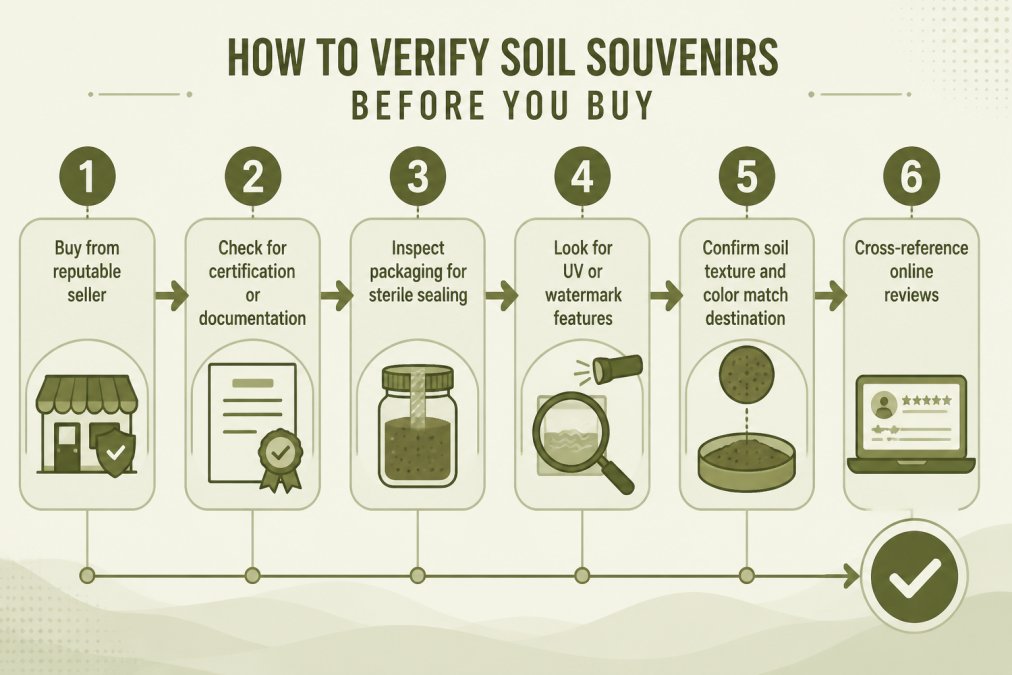
Work through this checklist before checkout:
- Confirm the seller names the specific destination, not just a country or region
- Look for documentation or certification of soil sourcing
- Check that the soil sits in a sealed cavity, not an open compartment
- Inspect product photos for tamper-resistant construction
- Read reviews and look for customer photos showing the item in person
- Verify the seller's return policy and contact information
The Real Cost of Authentic Soil Souvenirs
Authentic soil souvenirs cost more than an airport gift shop magnet, and the gap is not arbitrary. The price reflects sourcing work, regulatory awareness, sealed construction, and small-batch production rather than mass-produced assembly.
Frequently Asked Questions
Is it legal to bring soil souvenirs into the United States?
Generally, no. USDA APHIS prohibits most soil imports without a permit because soil can carry pathogens and invasive species. Travelers must declare any soil at customs. Non-compliant items may be seized, and you could face fines. Authentic souvenirs like FootWhere's are produced domestically using soil sourced and handled under U.S. regulations, so they don't involve international transport of raw soil.
How can I tell if a soil souvenir is authentic?
Look for transparency from the seller. Authentic souvenirs often include a certificate of authenticity, detailed provenance information, and tamper-evident packaging. FootWhere, for example, provides genuine soil in a sealed foot cavity and states its U.S. manufacturing. Be wary of unusually low prices or vague origin claims. If the seller can't explain how they sourced the soil, it's likely fake.
What are the USDA APHIS regulations regarding soil imports?
USDA APHIS regulates soil imports to prevent the introduction of plant pests and diseases. Under 7 CFR 330, soil from most countries is prohibited unless accompanied by a permit and subjected to quarantine or treatment. Travelers must declare soil, and unauthorized soil is confiscated. These rules apply to personal souvenirs, so bringing back soil from a trip can result in seizure and penalties.
Why is it difficult to verify the origin of soil in souvenirs?
Soil lacks unique chemical fingerprints that can be easily tested at home. While geological origin can sometimes be narrowed down through lab analysis, it's not practical for consumers. That's why provenance relies on seller documentation and reputation. Choose companies like FootWhere that are transparent about their sourcing and manufacturing. Without such verification, you're taking a gamble on authenticity.