

Table of Contents
- Why Travelers Are Searching for an Irish Corner Alternative
- Best Souvenirs for World Travelers: A Quick Comparison
- How to Choose Meaningful Souvenirs That Last
- Artisan vs. Mass-Produced: How to Tell the Difference
-
Regional Specialization: What to Look for by Destination
- The Rule: Match the Craft to the Landscape
- Cold, Textile-Producing Regions: Wool and Tweed
- Historic Glassworks Towns: Crystal and Glassware
- Pottery Regions: Ceramics and Local Clay
- Metalworking Traditions: Jewelry and Pewter
- Culinary Regions: Food and Drink Keepsakes
- How to Verify a Regional Claim on the Spot
- Sustainable and Eco-Friendly Souvenir Options
- Customs and Duty-Free Regulations for Souvenir Shoppers
- Frequently Asked Questions
Last Updated: September 20, 2026
Why Travelers Are Searching for an Irish Corner Alternative
Souvenir shopping has a trust problem. Travelers walk into airport gift shops and leave with fridge magnets stamped "Made in China," unsure whether anything on the shelf actually came from the place they just visited. That gap between "souvenir" and "genuine keepsake" is exactly why so many people are now hunting for an Irish Corner alternative for souvenirs: they want items with real provenance, not shelf filler.
Best Souvenirs for World Travelers: A Quick Comparison
Here's how the major categories stack up:
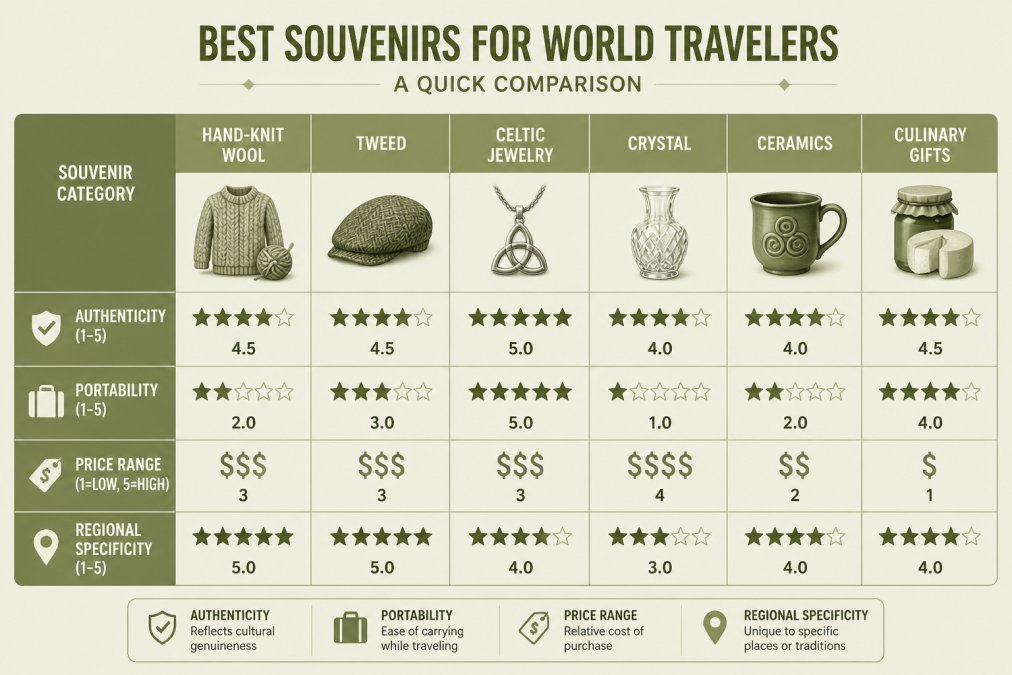
| Souvenir Type | Authenticity Signal | Portability | Best For |
|---|---|---|---|
| Hand-knit wool (fisherman sweater) | Hand-loomed, uneven stitches, cable patterns that vary stitch to stitch | Bulky | Cold-climate trips |
| Tweed and textiles | Mill stamp or heritage label sewn into the seam, not printed on a hangtag | Easy to pack | Gift-giving |
| Celtic jewelry (claddagh, pewter) | Hallmark or maker's mark stamped into the metal, not engraved after import | Very portable | Milestone keepsakes |
| Crystal and glassware | Etched maker signature on the base, often with a year | Fragile | Display pieces |
| Ceramics | Potter's stamp pressed into the wet clay on the base | Moderate | Everyday use |
| Culinary gifts | Local producer label with a town or county of origin | Consumable | Food lovers |
Comparison Table: Authentic vs. Mass-Produced Souvenirs
The fastest way to tell an artisan keepsake from an import is to check the label, the material, and the price logic. Mass-produced goods tend to be uniformly perfect, suspiciously cheap, and vague about origin.
| Signal | Authentic, Hand-Crafted | Mass-Produced |
|---|---|---|
| Labeling | Names the maker, workshop, or region | "Made in" with no town |
| Finish | Slight irregularity in stitch, glaze, or weight | Machine-perfect repetition |
| Price | Reflects labor and material | Priced to move volume |
| Story | Seller can explain provenance | No one knows who made it |
How to Read a Label Like a Buyer, Not a Tourist
Most shoppers never look past the front of a tag. The back is where the real information lives, and the difference between a genuine piece and a dressed-up import usually comes down to four checks:
- Country of origin vs. country of design. "Designed in" is not "made in." A product can be designed locally and manufactured overseas, and the label will say so if you read the fine print.
- A named town or county. Genuine regional crafts usually name the place, a specific mill, a specific pottery town, a specific county. A vague national label is a warning sign.
- A maker or workshop name. Independent artisans sign their work. Factories don't.
- A fiber or material composition line. Wool, linen, clay, pewter, and glass are regional materials. "Acrylic blend" or "metal alloy" tells you the item was built to a price, not a place.
The Price Reality Check
Hand labor costs money, and that cost shows up in the price. A hand-knit sweater takes many hours of work; a machine-knit one takes minutes. If the price looks like the machine version but the tag claims hand-made, one of those two things is wrong. The same logic applies to hand-thrown ceramics, hand-cut crystal, and hand-set jewelry.
What Each Category Costs You in Space and Risk
Portability is not just about weight. Fragile categories, crystal, glassware, ceramics, carry breakage risk on the trip home and often need to be hand-carried rather than checked. Textiles and jewelry pack flat and survive a suitcase. Culinary gifts are the easiest to carry but the most likely to be restricted at customs.
How to Choose Meaningful Souvenirs That Last
Meaningful souvenirs are the ones tied to a specific memory, maker, or material, not the ones that look nice on a rack. Choose items you'll actually use or display, and buy from independent boutiques and local markets rather than tourist-trap gift shops.
The Provenance Test: Questions to Ask Before You Buy
Before any purchase, run through these questions:
- Who made this, and can the seller name them?
- Where exactly was it produced, not just "imported from"?
- What material is it, and does the material match the region?
- Is the price consistent with hand labor, or too cheap to be real?
- Can I get a receipt that documents the origin for customs?
If the seller can't answer two or more of these, you're likely looking at an import dressed up as a local craft.
Artisan vs. Mass-Produced: How to Tell the Difference
Artisan goods show the marks of human hands: slight variations in stitch, glaze, or weight. Mass-produced items are identical, and that uniformity is the tell. Look for maker's marks, heritage labels, and small inconsistencies that prove individual craftsmanship.
Regional Specialization: What to Look for by Destination
Every region has a specialty worth seeking out, and buying the local one beats buying a generic version. The problem with most souvenir guides is that they stop there, they tell you to buy local without telling you what local actually means in each place. This section maps the craft to the region so you know what to look for before you walk into a shop.
The Rule: Match the Craft to the Landscape
Crafts grow out of what a place has. Wool comes from sheep country. Pottery comes from clay country. Glass comes from places with the fuel, sand, and water to run a furnace. When you understand why a region makes what it makes, you can spot an import instantly: a wool sweater sold in a region with no sheep and no mills is almost certainly not local.
Cold, Textile-Producing Regions: Wool and Tweed
Regions with a history of sheep farming and water-powered mills are where you find genuine hand-knit wool and tweed. Look for:
- Hand-loomed sweaters with cable patterns that vary slightly from stitch to stitch, a machine cannot reproduce that irregularity.
- Tweed sold by the yard or as finished garments, with a mill stamp woven into the selvedge edge rather than printed on a hangtag.
- Natural, undyed fleece colors, cream, gray, brown, which come from the sheep, not a dye vat.
Historic Glassworks Towns: Crystal and Glassware
Crystal and glassware come from towns with a long history of glassmaking, places where the furnaces never went out. The tell is the finish:
- Hand-cut crystal has facets that catch light unevenly because a person held the wheel.
- Etched maker signatures on the base, often with a year, are the strongest authenticity signal in this category.
- Weight and ring, lead crystal is heavy and rings when tapped; cheap glass thuds.
Pottery Regions: Ceramics and Local Clay
Ceramics come from places with local clay and a pottery tradition. The marker is on the base:
- A potter's stamp pressed into the wet clay before firing, not painted on after.
- Glaze colors that reflect local minerals, iron-rich clays fire to warm browns and reds, not uniform factory white.
- Slight asymmetry in the rim or foot, which is the signature of a hand on a wheel.
Metalworking Traditions: Jewelry and Pewter
Jewelry and pewter come from regions with a metalworking heritage. The authenticity signal is the hallmark:
- A stamped hallmark or maker's mark in the metal itself, not engraved after the fact.
- Weight in the hand, solid pewter and silver feel dense; plated base metal feels light.
- Claddagh and Celtic knot designs executed with clean, hand-finished detail rather than stamped repetition.
Culinary Regions: Food and Drink Keepsakes
Food and drink souvenirs are tied to specific growing and producing regions, a whiskey region, a cheese region, a smoked-fish coast. Buy from producers who name the town or county on the label, and check customs rules before you pack anything edible or alcoholic.
How to Verify a Regional Claim on the Spot
Before you buy, ask the seller three questions: What town was this made in? Who made it? What is it made of? A genuine regional artisan can answer all three without hesitating. A reseller of imports usually can't answer any of them. That thirty-second conversation is worth more than any label.
Sustainable and Eco-Friendly Souvenir Options
Sustainable souvenirs are locally-made, use natural or recycled materials, and support the maker directly. They avoid plastic trinkets shipped thousands of miles and thrown away within a year. Choosing them cuts waste and keeps more money in the local economy.
Look for these markers:
- Natural materials: wool, linen, clay, wood, pewter
- Refillable or reusable items instead of single-use
- Packaging that's minimal or recyclable
- Makers who source materials locally
Customs and Duty-Free Regulations for Souvenir Shoppers
U.S. travelers returning from abroad must declare purchases and may owe duty above a personal exemption. The rules depend on what you bought, where it was made, and how long you were away. Always keep receipts for hand-crafted and high-value items.
A few practical points to keep in mind:
- Keep all receipts and maker documentation for anything valuable.
- Some materials (certain woods, animal products, food) face restrictions.
- Hand-crafted goods still count toward your exemption total.
- Declare accurately; undeclared items can be seized.
Frequently Asked Questions
What is a must-have souvenir that is actually authentic?
Look for items with documented provenance: hand-knit wool sweaters from specific mills, hand-thrown ceramics signed by the maker, or traditional tweed woven in-region. The key is traceability. Ask the seller where the item was made, who made it, and whether materials were sourced locally. Items with certificates of authenticity, maker signatures, or cooperative labels carry more weight than generic 'made in' stamps. Authentic souvenirs reflect a specific place's materials and techniques, not just its name printed on a product.
How can I identify high-quality, locally made souvenirs?
Check for irregularities that signal hand production: slight variations in stitch tension on knitwear, visible tool marks on ceramics, or natural color variation in wool. Mass-produced items are uniform to the point of looking stamped. Also examine the label. A label naming a specific workshop, cooperative, or artisan is a stronger signal than a vague country-of-origin tag. Finally, ask questions. Sellers at independent boutiques and local markets can usually explain the item's origin and materials without hesitation.
Are there alternatives to mass-produced keychains and magnets?
Yes. Consider small-batch ceramics, hand-bound notebooks, locally woven textiles, artisan food products, or bespoke jewelry. These items carry the character of a place in their materials and methods, not just their branding. For travelers who want something compact, consider items that incorporate genuine elements of the destination, such as soil, stone, or locally sourced wood. The goal is a keepsake that tells a story about where you actually went, not where a factory happened to be.
What makes a souvenir truly meaningful for a traveler?
Meaning comes from connection: the item should remind you of a specific moment, place, or person. A souvenir tied to a particular experience, like a wool scarf bought at the farm where the sheep graze, carries more weight than a generic trinket. Personalization also matters. Items that can be customized with dates, names, or locations transform from decorative objects into personal records. Finally, durability matters. A keepsake you can use or display for decades holds more meaning than something that breaks in a drawer.